
Look-Ahead Bias in Backtesting: The Problem Hidden in Your Data
Backtesting is one of the most critical steps in developing a trading strategy. Before exposing actual capital to risk, traders and analysts evaluate their concepts using historical market data to determine how the approach would have performed in the past. A successful backtest can offer reassurance that a strategy merits deeper exploration.
Nevertheless, backtesting has a well-known flaw: when historical data is misapplied, the outcomes can appear far superior to anything achievable in live trading, a problem known as look-ahead bias.
Anyone who has spent time building trading strategies is likely familiar with the usual warnings regarding look-ahead bias:
- Don’t use future prices when calculating signals.
- Execute trades on the next bar, not the current one.
- Lag indicators appropriately.
- Never reference information that wasn’t available at the time of the trade.
These are all accurate and significant points. Every quantitative developer needs to know how to avoid such issues.
Yet, another type of look-ahead bias exists that frequently goes unnoticed. It does not come from the code; it comes from the data itself.
Often, even flawlessly constructed backtesting code can produce deceptive outcomes when the historical data includes details that were inaccessible at the moment decisions were being made.
The Look-Ahead Bias Everyone Knows
Errors in implementation produce the most common cases of look-ahead bias.
A common example is a strategy that calculates a moving average based on the current day’s closing price and then executes a trade at that same closing price. But the closing price is only known once the market closes, so the trade could not have been placed using that information.
Another typical error involves incorporating future data points when calculating technical indicators or producing trading signals. Even a single future value accidentally included in a calculation gives the strategy insight it could never possess during actual live trading.
Since these mistakes are widely recognized, developers typically follow several basic rules:
- Generate signals using only historical information.
- Execute trades on the next available bar.
- Never include future observations in indicator calculations.
Modern backtesting frameworks often make these practices easier to follow, and experienced developers usually recognize these mistakes during code reviews.
However, avoiding these coding errors does not ensure a backtest is entirely free from look-ahead bias.
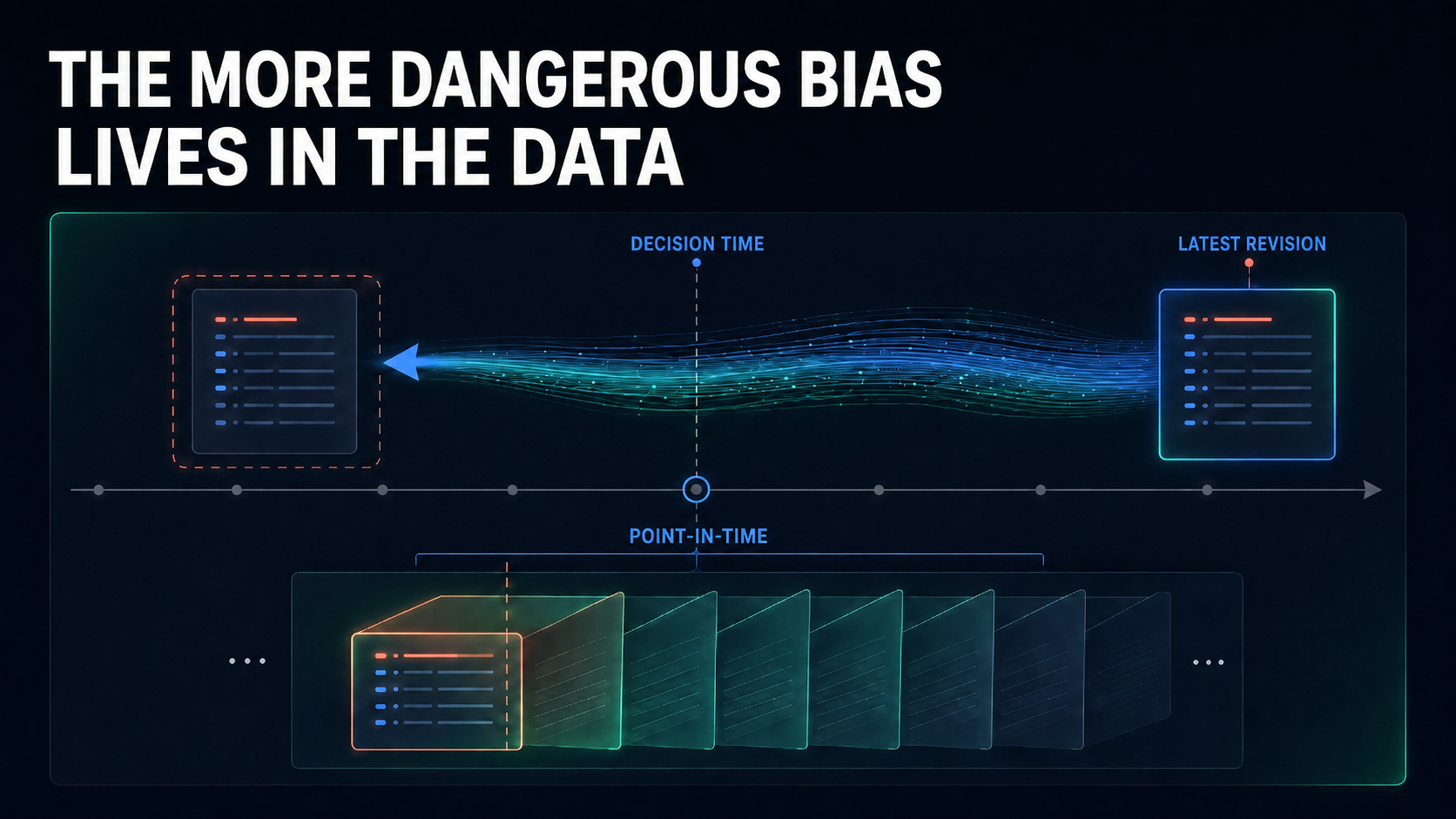
The More Dangerous Bias Lives in the Data
A more subtle form of look-ahead bias occurs when historical data include values that were later corrected or updated.
Many economic and financial datasets are not fixed. Governments revise their economic statistics, companies adjust their financial reports, data providers fill in missing entries and stock indices frequently change their membership. When a historical dataset stores only the latest version of these values, a backtest might unintentionally rely on details that were not accessible at the moment the original decision was made.
From the viewpoint of the backtesting system, everything appears normal, as the code simply processes whatever data it is given. The problem is that these numbers reflect present-day knowledge, not what investors actually knew when they made those decisions.
As a result, the strategy appears more successful than it could ever have been in live trading.
Revised GDP Data
A simple macro strategy buys equities whenever quarterly real GDP growth exceeds 1.5%.
The first estimate for U.S. GDP growth in the first quarter of 2023 was released on April 27, 2023, at 1.1%. A strategy running that day would not have generated a buy signal because growth was below the threshold. Over the following two months, the Bureau of Economic Analysis revised the same quarter twice, first to 1.3% and finally to 2.0% as more complete source data became available.
Downloading the latest historical GDP series today typically returns the final revised value of 2.0%, not the original 1.1% available to investors on April 27\. A backtest using that revised dataset therefore generates a trade that could never have occurred in real time.
Python:
| import pandas as pd

threshold = 1.5

# Final revised GDP value available today
revised = pd.DataFrame(
    {"gdp": [2.0]},
    index=["2023-04-27"]
)

# GDP value available on the original release date
point_in_time = pd.DataFrame(
    {"gdp": [1.1]},
    index=["2023-04-27"]
)
revised["buy_signal"] = revised["gdp"] > threshold
point_in_time["buy_signal"] = point_in_time["gdp"] > threshold

print("Latest revised data")
print(revised)

print("\nPoint-in-time data")
print(point_in_time)Output:
Latest revised data
            gdp buy_signal
2023-04-27  2.0        True

Point-in-time data
            gdp buy_signal
2023-04-27 1.1 FalseThe trading logic never changes: the strategy buys whenever GDP growth exceeds 1.5%. The only difference is the dataset it receives.
Using today’s revised GDP series produces a buy signal because the final estimate is 2.0%. A point-in-time dataset correctly reproduces the information available on April 27, 2023, when investors only knew that GDP growth was 1.1%, so the strategy remained out of the market.
Restated Financial Statements
A company reports quarterly earnings of $0.95 per share.
Based on those figures, a value strategy determines that the stock is overpriced and skips the trade.
Months later, the company uncovers an accounting mistake and revises its financial reports:
- Original EPS: $0.95
- Revised EPS: $1.18
If the historical fundamentals database quietly replaces the original filing with the corrected version, the backtest now shows higher earnings than what investors actually saw on the announcement date.
The strategy suddenly identifies an appealing buying opportunity that didn’t exist in real time.
Investors never saw the revised $1.18 figure when they made their decision, yet the backtest behaves as though they had.
Backfilled Data
This issue also appears in earnings databases.
A company releases its earnings after the market closes on Tuesday. The data provider needs the night to process and publish them, so subscribers do not receive the finalized figures until Wednesday morning.
Yet, certain historical records simply assign the earnings to Tuesday’s date, as that marks the official announcement. A backtest relying on daily data assumes the earnings were instantly accessible during Tuesday’s trading hours, even though traders could not use the cleaned dataset until the next day.
Even a lag of just a few hours can significantly impact a backtest’s accuracy, since the information was not available when the model assumes it was.
Reconstructed Index Membership
Index composition introduces another subtle issue.
Consider a strategy that trades only stocks in the S&P 500.
It’s easy to download the current list of index constituents. However, this list differs from what investors would have seen five or ten years ago.
Firms are constantly added to or removed from the list due to mergers, bankruptcies, declining market capitalization or changes in eligibility criteria.
Suppose the backtest runs on 2015 data but uses the S\&P 500’s current membership.
The backtest accidentally excluded companies later dropped for underperformance while including firms that had not yet joined the index.
This creates a classic case of survivorship and look-ahead bias: the strategy gains an advantage by knowing which companies would later succeed enough to stay in the index.
A proper point-in-time dataset records the precise index members for each historical date, ensuring the investment universe evolves exactly as in reality.
Why Code Reviews Cannot Detect This
One reason this particular form of look-ahead bias is so dangerous is that it is rarely caught during code reviews.
A reviewer might closely examine the logic and verify that:
- signals are correctly lagged;
- trades only execute on the next bar;
- indicators rely exclusively on historical data;
- no future prices are referenced.
At first glance, everything looks correct.
The reviewer typically assumes the input data accurately reflects what was known at every historical point. When the data vendor has silently replaced original values with updated ones, the bias becomes entirely invisible within the source code.
In other words, even perfectly written software can still generate a fundamentally flawed backtest.
Point-in-Time Data: The Correct Solution
The most dependable approach involves using point-in-time data.
Unlike standard historical datasets, point-in-time databases capture information exactly as it was accessible on any given date. Rather than overwriting old values with corrected ones, they preserve a complete record of every version published over time.
If a corporation initially reports a specific earnings number and later publishes a correction, both versions are stored. When a backtest simulates a decision made before the correction, it only accesses the original value, since that was the data available to investors at the time.
Instead of asking:
“What was GDP for Q1 2023?”
A point-in-time backtest asks:
“What did investors believe the GDP for Q1 2023 was on April 27, 2023?”
This identical logic applies to:
- Economic data releases, along with their subsequent adjustments.
- Corporate financial reports and their later restatements.
- Analyst projections across different time periods.
- Index compositions as they stood on each historical date.
- Corporate actions and other market metadata.
Point-in-time datasets allow backtests to use exactly the information that was available on each historical date, significantly reducing the risk of hidden look-ahead bias.
Conclusion
Look-ahead bias is widely regarded as one of the greatest threats to trustworthy backtesting. Most discussions focus on coding mistakes, and for good reason: using future prices or executing trades too early can completely invalidate a strategy. An equally important source of bias often comes from the data itself.
Revised economic statistics, restated financial statements, backfilled datasets and reconstructed index membership can all introduce information that was unavailable when the original investment decision was made. Even perfectly written code cannot correct data that already contains knowledge from the future.
Avoiding this form of look-ahead bias requires more than careful programming. Point-in-time datasets preserve every historical version of economic releases, financial statements, analyst estimates and other time-sensitive information, allowing a backtest to use only what investors actually knew at each point in time. Historical security master data plays an equally important role by keeping changes to identifiers, index membership, corporate actions and other reference data exactly as they existed on each historical date.
Reliable backtesting depends as much on data quality as on code quality. Without point-in-time data and historical security masters, even a carefully implemented strategy can produce results that would never have been achievable in live trading.
This content is for educational purposes only.
Spread the word:
