
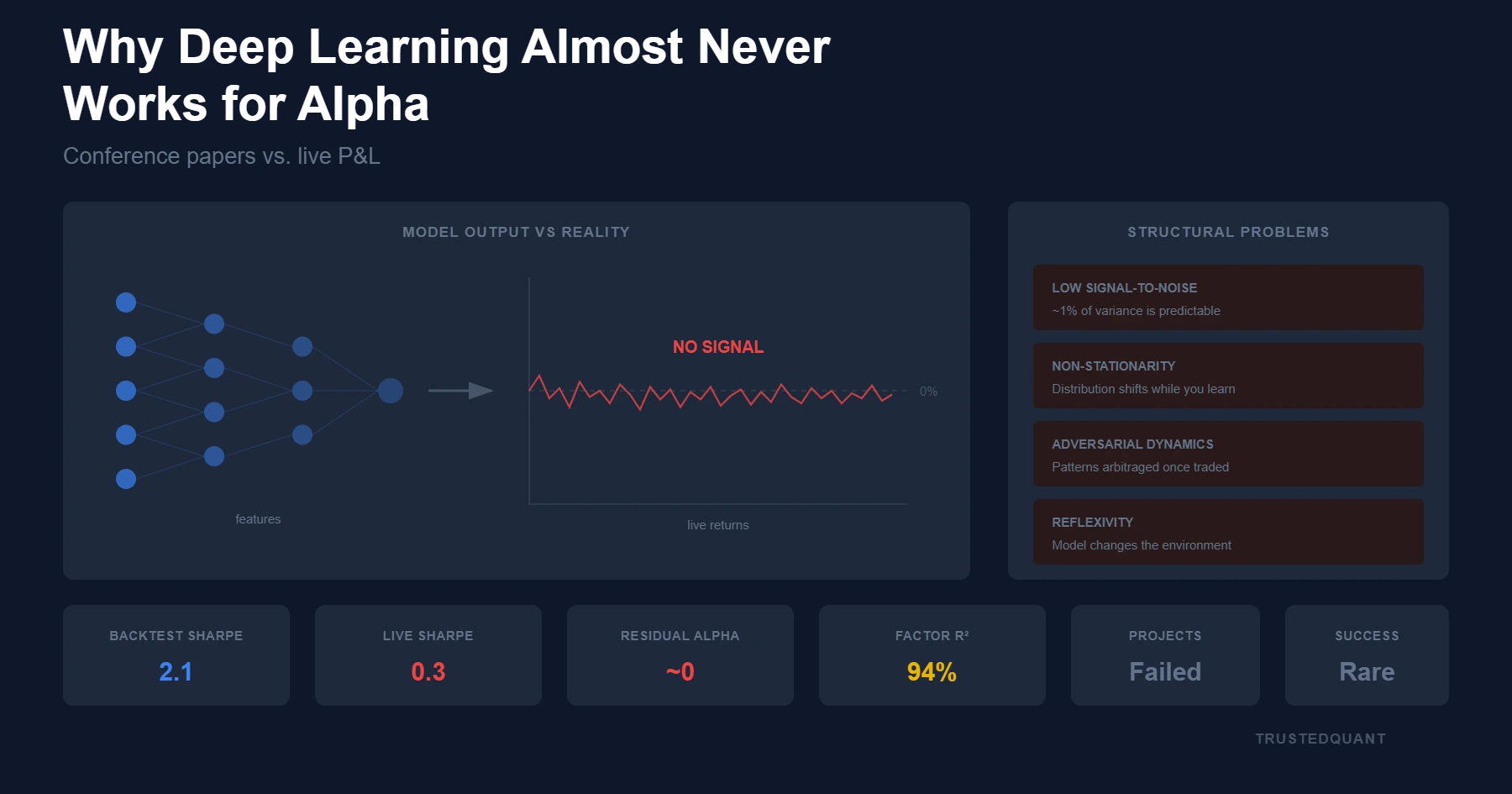
Why Deep Learning Doesn’t Work for Trading
Deep learning has transformed vision, language, and games, while doing almost nothing for alpha generation. The gap between conference papers and live P&L remains vast and persistent despite a decade of serious attempts by teams with significant compute, data, and talent, and the success stories are rare, narrow, and often misleading.
The structural properties of alpha generation are adversarial to the strengths of deep neural networks. Methods that work spectacularly when data is abundant, stationary, and labeled fail when data is scarce, non-stationary, and self-referential.
The Data Problem
Deep learning requires large datasets, and financial data is not large in the relevant sense.
A decade of daily returns for 3,000 US equities gives you roughly 7.5 million observations, which sounds like a lot until you realize each observation is a single target variable with perhaps a few hundred features. A vision model trains on millions of images with millions of pixels each while a language model trains on trillions of tokens, so the information density in financial data is orders of magnitude lower.
Increasing frequency doesn’t help as much as it seems because minute bars give you more observations while the signal-to-noise ratio collapses. You end up fitting to microstructure artifacts rather than to anything that predicts returns, which means the additional data points are real while the additional signal is not.
Cross-sectional expansion helps marginally. Adding international equities, futures, options, and alternative data increases the dataset size along with the heterogeneity, but a model trained on US large-cap equities doesn’t transfer cleanly to emerging market small-caps because the data isn’t i.i.d. across instruments in any meaningful sense.
Non-Stationarity
Even if you could assemble enough data, the distributions shift in ways that defeat learned representations.
The joint distribution of features and returns changes over time, so a pattern that predicted returns in 2015 may not predict returns in 2020. The drift is continuous rather than confined to discrete regime changes, which means the function you are trying to learn is moving while you learn it.
Deep networks are universal function approximators that excel at learning complex stable mappings from inputs to outputs. When the mapping itself is unstable the network learns a weighted average of historical relationships, many of which no longer hold, and the learned function becomes an accumulation of expired regimes.
Walk-forward retraining is the standard response where you retrain the model periodically on recent data and let it adapt to the current regime. This works better than static models while introducing its own problems because the model now has even less data per training window and the features it relies on may require longer histories to estimate reliably. You trade off adaptability against statistical power, and both sides of that tradeoff are losing.
The Label Problem
Supervised learning requires labels, and in alpha generation the labels are future returns, and future returns are mostly noise.
Daily return variance in equities is dominated by market-wide factors, sector factors, and idiosyncratic noise, while the component that might be predictable from your features is small. You ask a neural network to find a signal that explains perhaps 1% of the variance in an already noisy target.
Cross-entropy loss on direction doesn’t help because predicting whether the next return is positive or negative is still predicting something that is close to 50/50 in most universes. The class imbalance isn’t the problem. The predictable component of direction is small and the network has no way to distinguish between learnable signal and unlearnable noise during training.
Given enough capacity the network will find patterns in the training data that don’t generalize. Regularization helps at the margins through dropout, weight decay, and early stopping, but these techniques reduce overfitting without eliminating it because the fundamental issue is that the true signal is weak enough that a sufficiently flexible model will always find spurious patterns that fit better.
Adversarial Dynamics
Alpha is zero-sum, so every dollar of alpha you capture comes from someone else’s loss, and that someone else is paying attention.
When a pattern becomes known and traded it gets arbitraged away. The network learns a pattern from historical data and you deploy capital on that pattern while other participants with the same data and similar models are doing the same thing, so the pattern weakens or inverts and the learned relationship stops working precisely because it worked.
Factor decay is well-documented across the industry. Momentum worked better before everyone traded momentum and value worked better before everyone traded value. Deep learning doesn’t escape this dynamic and may accelerate it because the patterns a network finds are often the same patterns other networks find since they train on the same data with similar architectures.
The network has no way to model its own impact on the market. It learns from a historical record where it wasn’t present, and once deployed the environment changes in response to its presence.
What Actually Gets Learned
When deep learning does appear to work in finance it is usually doing something other than alpha generation in the portfolio return sense.
Sometimes it learns execution. Predicting short-term price moves conditional on order flow is a legitimate use of pattern recognition where the signal exists, is measurable, and translates to reduced transaction costs. This is valuable for implementation efficiency while being distinct from return prediction.
Sometimes it learns risk factors. A network trained to predict returns may actually be learning a nonlinear combination of known risk exposures, so the predictions look good because they load on factors that happen to perform well in the test period. This amounts to a complicated way to take factor risk.
def decompose_predictions(model_returns, factor_returns):
    X = factor_returns
    y = model_returns
    reg = LinearRegression().fit(X, y)
    explained = reg.predict(X)
    residual = y - explained
    return {
        'factor_r2': reg.score(X, y),
        'residual_sharpe': residual.mean() / residual.std() * np.sqrt(252),
        'factor_loadings': dict(zip(factor_returns.columns, reg.coef_))
    }
If the residual Sharpe after factoring out market, size, value, momentum, and volatility is close to zero then the network found a complicated way to express factor exposure rather than genuine alpha.
Calendar effects account for more published results than anyone admits. A network trained on 2010-2017 and tested on 2018-2019 may look good because those years were kind to the strategies the network implicitly learned, and extending the test to 2020-2023 often makes the performance disappear.
Architecture Doesn’t Save You
Even sophisticated architectures cannot overcome the fundamental limits imposed by scarce data, unstable distributions, and noisy labels.
The literature is full of architectural innovations applied to financial prediction. LSTMs for sequence modeling, transformers for attention over historical windows, graph neural networks for relational structure between assets, and temporal fusion transformers for multi-horizon forecasting.
Yet, despite this sophistication, none of these architectures overcome the fundamental limitations of financial data.
LSTMs learn temporal dependencies in time series that have weak and unstable temporal dependencies. Transformers learn attention patterns over historical returns that are mostly noise. Graph neural networks model relationships between assets that shift with regimes, so they learn a snapshot of a moving object. More parameters, more layers, and more sophisticated architectures make the overfitting problem worse because the constraint on performance isn’t model expressiveness but signal.
When It Might Work
Despite these limitations, there are narrow conditions where deep learning has a plausible edge.
Proprietary order flow data at high frequency offers real signal that others don’t have, and if you predict at horizons short enough that the signal hasn’t decayed then a neural network might extract patterns that simpler models miss. The edge comes from the data rather than the architecture.
Alternative data sometimes contains genuine information content. Satellite imagery, credit card transactions, and web scraping are data sources that aren’t in everyone’s database and might contain signal that a network can extract. The network’s role here is feature extraction from unstructured data rather than return prediction directly.
Large portfolios with complex execution needs can benefit from learned policies because the interaction between multiple orders across correlated assets is complex enough that neural networks may outperform heuristics. The objective is cost minimization rather than return prediction, and the feedback loop is tight enough that online learning can adapt to changing conditions.
These are real applications with genuine value. They are narrower than what most people mean when they talk about deep learning for alpha.
The Honest Assessment
Most deep learning projects in quantitative finance follow a predictable arc where initial excitement about a new architecture or data source leads to promising backtest results after extensive hyperparameter tuning, which leads to degraded performance in paper trading, which leads to failure or marginal performance in live trading, which leads to post-hoc rationalization about data issues or regime change.
The teams that avoid this arc usually do so by not using deep learning for alpha generation but instead using it for NLP on filings and transcripts, for image processing on alternative data, or for trade execution optimization.
Every few years a new cohort arrives with better compute, better architectures, and confidence that this time will be different, while the structural problems remain unchanged. Alpha generation has properties that deep learning isn’t designed to handle, including low signal-to-noise ratios, non-stationary distributions, adversarial dynamics, and reflexivity. More depth and more data haven’t solved these problems because they aren’t problems of model capacity.
The honest prior on any new deep learning alpha project is that it probably won’t work. The projects that do work usually constrained the problem to something much narrower than predicting returns.
This content is for educational purposes only.
Spread the word:
